

Dry Lining vs. Wet Plastering – Which is Right for Your Bedfordshire Renovation?
If you’re in the middle of a Bedfordshire renovation, you’ve probably arrived at the ‘plaster vs. dry lining’ question and you’re needing straight answers. At Logic Plastering, we’ve worked over a decade on local sites – from Sandy to Luton – helping builders and DIYers make this exact call, so: what are the benefits of dry lining and when would you choose it over plaster work?
We’re not going to sell you the most expensive option – after all, we want you to tell other people we gave you the right advice! Our aim is to get your walls paint-ready in the best way for your project. After 10 years of skimming and boarding across the county, we know that while traditional wet plaster has its place, dry lining is more often than not the secret to a high-spec, high-speed finish.
Why Dry Lining is the Right Choice – The Practical Benefits

At Logic, we’ve had plenty of time to figure out exactly where dry lining offers the most value. In the right context – like a loft conversion or a garage knock-through – the rewards are immediate.
It’s a dry process, which means less mess and a quicker transition from building site to living space. Additionally, we take care to use the right boarding system for your needs, which gives your room a high-performance skin that offers, hands down, more benefits than traditional plastering.
- Acoustic Shielding – If you’re sick of hearing the neighbours, we can install high-density sound boards. It’s a massive boost to your wellbeing without costing you a fortune.
- Moisture Control – In kitchens and bathrooms, we use moisture-resistant ‘green board’ to prevent the damp and mould issues that plague older skim-only jobs.
- Fire Safety – We use fire-rated boards in high-risk areas (like under stairs or in kitchens), giving you the kind of confidence that a simple wet skim just can’t provide.
- Crack Resistance – Dry lining allows for a small amount of movement. In new builds or extensions that are still settling. This flexibility means fewer hairline cracks compared to rigid wet plaster.
How Logic Plastering Dry Lines Your Walls
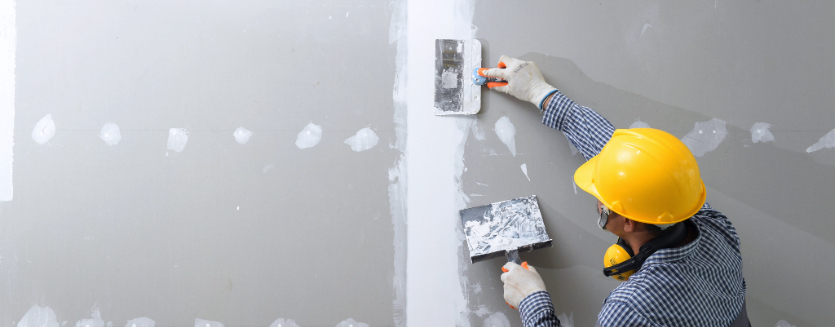
Before we start work, we’re looking at two things – how straight your walls are and how much the brick is going to ‘pull’ (the suction). We don’t just hope for the best when we’re dry lining; we check the masonry out first. Because if our prep isn’t spot on, the boards won’t sit right. For us, our job is all about making sure the wall is rock-solid and actually helps keep your heating bills down.
Direct Bonding for Solid Walls
When we’re dealing with bare brick or blockwork in a Bedfordshire refurb, ‘dot and dab’ is the approach we normally take. It’s a dry-lining method where we bond the plasterboard directly to the wall using specialised adhesive. In an older house that’s ‘moved’ over the last 50 years, this technique is how we get walls square again.
Screw-Fixing for New Walls
For new partitions, we screw the boards into the frame. This is where we can really customise the room, by adding extra-thick acoustic board to a home office or moisture-resistant boards for a new en-suite bathroom.
Making the Most of the Cavity
Whether we’re dabbing adhesive onto brick or screwing boards to a timber frame, both methods create a void behind the wall. This space is a bit of a gift; it’s where we tuck away your wiring or fit high-spec insulation.
The Clear Comparison – Plastering vs. Boarding
You might hear people say dry lining is just the ‘cheap’ option. After a decade in the trade, we can tell you that’s a myth. It’s about choosing the right tool for the job.
Here’s a breakdown of what you’re actually getting with each.
|
Feature |
Wet Plastering |
Dry Lining (Logic’s Choice) |
|
Speed |
Slow (Weeks to dry) |
Fast (Ready in 48 hours) |
|
Finish |
Traditional, hard-wearing |
Smooth, perfectly plumb |
|
Mess |
High (Lots of water/dust) |
Low (Clean and contained) |
|
Insulation |
Minimal |
High (With thermal boards) |
Finishing Your Walls For Lasting Quality
At Logic, we don’t just want your walls to look good when we leave; we want them to look good in five years. The finishing stage is where dry lining meets traditional plastering.
- Why We Usually Skim – In most Bedfordshire refurbs, we suggest a full skim over the dry lining. It adds an extra layer of soundproofing and fire resistance, but more importantly, it makes the wall feel totally solid.
- The Taping Alternative – If you’re on a tight budget or working in a utility space, taping and jointing the tapered edges of the boards is a solid, cost-effective choice. And it’s ‘paint-ready’ much faster.
- The Logic Way – Whatever you choose, we make sure the beading (the metal or plastic strips on the corners) is absolutely straight. Whether it’s a skim or a joint, poor corner finishing will ruin the look of the whole room.
Logic FAQs – What You Need to Know About Dry Lining
We want you to feel 100% confident that you’ve made the right choice. Here are some of the questions we get asked regularly by clients as they make their decision.
Can I dry-line the walls myself?
You can have a go at tacking boards to studs, but ‘dot and dab’ is trickier than it looks. Getting a wall perfectly plumb and level takes training and experience. If you get it wrong, your skirting boards and coving will never sit straight.
How long does it take to dry?
That’s the beauty of it—it doesn’t! While a thick coat of wet plaster can take weeks to fully cure, dry lining is ready for a mist-coat of paint almost as soon as the joints are dry. If we’re skimming over the boards, you’re looking at 2-3 days max.
Is dry lining better for soundproofing?
Much better. By choosing a specific high-density acoustic board and leaving that air gap, we can significantly reduce the noise coming through from the neighbours. It’s a massive upgrade for semi-detached houses.
Can I hang a heavy TV or radiator on a dry-lined wall?
Yes, you just need the right fixings. Because there’s a gap behind the board, we use brolly anchors or Corefix bolts that bite into the masonry behind. If we know where your heavy items are going, we can always double-board those areas for extra strength.
About Logic Plastering
We are a local drywall contractor working across Bedfordshire. Our skilled tradesmen offer a range of dry lining services, and we always provide a FREE no obligation quote on all the work we do.
We’ve been around for over a decade, and we’re proud of the local reputation we’ve built in that time. Ask anyone we’ve worked for, and they’ll tell you we can be relied upon to turn up when we say we will, complete the work to deadline, and do a great job!
If you’re based in Bedfordshire and considering dry lining for your project, contact Logic Plastering today for expert advice and a free, no-obligation quote – 07809 228328